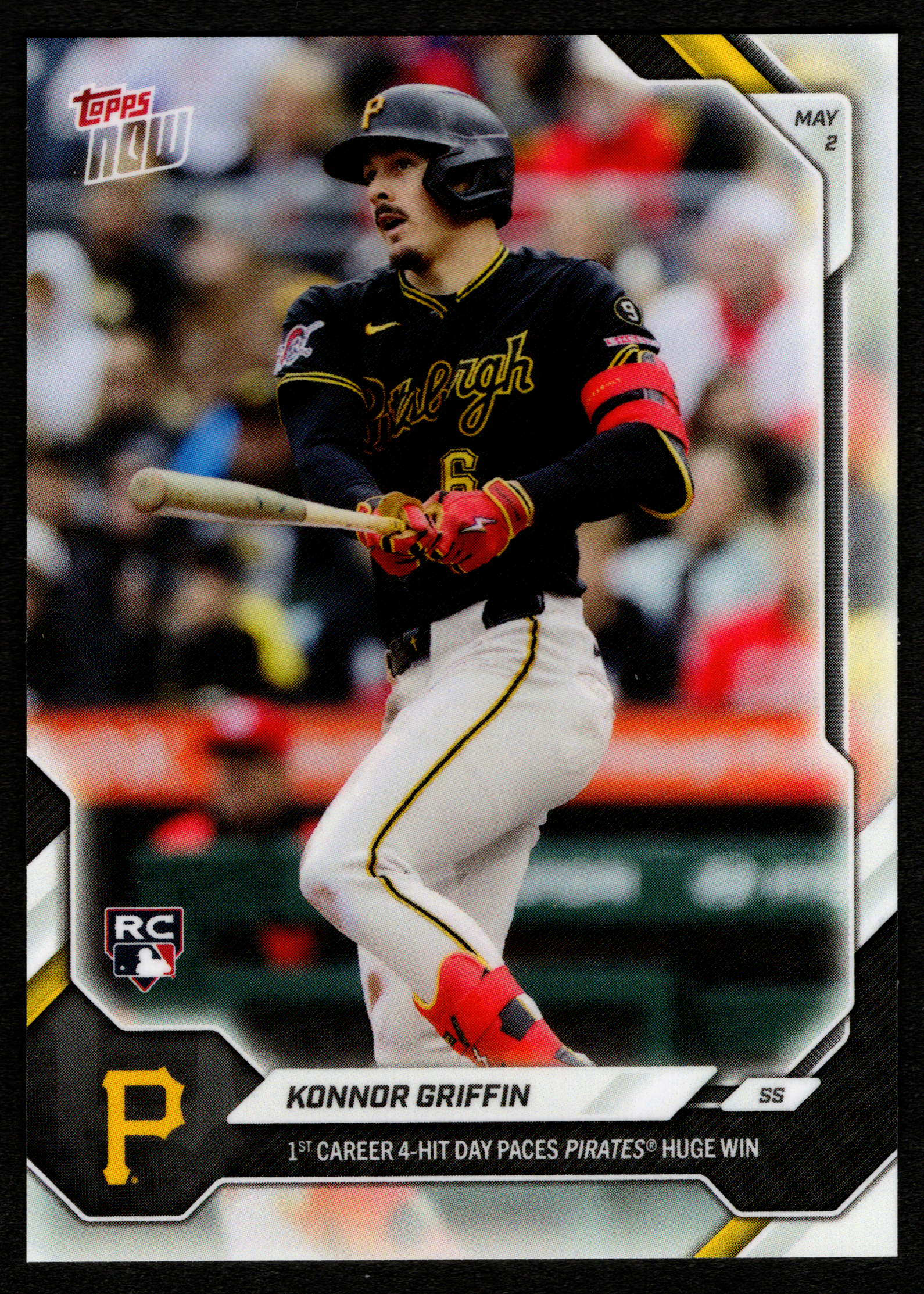
Gem Mint10
Konnor Griffin
2026 Topps Now #154
Serial 5437410

Closed-Loop Grading Software
CardFax is not another AI grading tool. It is a closed-loop grading engine built on MOSES, our proprietary model — thousands of calibrated data points sharpen it with every card it grades, and deterministic math turns its measurements into a grade you can verify. Every card is registered on the CardFax Registry for life.
2026 Topps Now #154
Serial 5437410
Serial 5437410The 4Q
Model: MOSES · Registered on the CardFax
Click the card to flip it · live from the registry
$ cardfax grade --serial 1935851
[scan]card detected · isolated · 8 corners cropped
[moses]TL 10 · TR 10 · BL 9.5 · BR 10 · library match confirmed
[centering]front 58/42 · back 68/32 · set priors applied · 9.5
[edges]9.5 · surface 10 · no print lines detected
[loop]evidence captured · 8 data points into the training loop
[registry]registered on the CardFax · population updated
CARDFAX 10 · GEM MINT
1,711+
Cards graded and registered
12,000+
Corner measurements feeding MOSES
4
Analysis layers per corner
58s
Average grading time
The Engine
Model for Optical Scanning and Evaluation System
There is a new AI grading app every week, and the pitch is always the same — “micron-level precision,” “trained on thousands of cards,” “eliminates human bias” — adjectives with no numbers attached, wrapped around someone else's general-purpose AI. Ours is arithmetic. MOSES — the Model for Optical Scanning and Evaluation System — renders 32 corner verdicts on every card (8 corners through 4 analysis layers), measures centering against published buffers (60/40 front, 75/25 back, weighted 80/20), and averages 58 seconds from scan to registered grade — measured in production, down from 223 seconds one engine release ago. Behind it sit more than 2,000 hand-calibrated corner samples we own and 12,000+ production corner measurements, refreshed by the training loop every 30 minutes. Every claim in this paragraph has a number attached — and every grade is auditable on the public registry.
Border ratios measured against published buffers — 60/40 front, 75/25 back, weighted 80/20 — with diamond-cut tilt detection at a 3% corner delta. The formula is public. Check our math.
Enhanced-signal analysis detects hairline scratches, print lines, and indentations invisible to the naked eye — then severity is scored in the natural view, front and back alike, with magnified quadrant review.
58 seconds on average from scan to registered grade — measured in production — and the result is an immutable condition record on the CardFax, verifiable by anyone, for life.
Just another AI app
CardFax + MOSES
Anyone can take a picture and ask an AI to grade a card. Only one has a model forged by professional graders — MOSES — trained on a proprietary data library thousands of records deep, against published whitepapers and formulas, with every release on the record.
The Closed Loop
Most grading software is frozen the day it ships. CardFax runs a loop: grade, record, calibrate, release. The data never leaves the loop, and the loop never stops.
01
Every card is measured — eight corners, border geometry, edge and surface signal — and the evidence behind each subgrade is captured, not discarded.
02
Those measurements land in proprietary datasets: a curated corner library, similarity indexes, and examiner feedback. Thousands of calibrated data points, growing with every card.
03
Blind calibration keeps the model honest — examiners review corners without seeing the machine's answer, and every disagreement becomes training signal.
04
Improvements ship as versioned engine releases, on the record. Every card graded after a release runs on a sharper MOSES than the card before it.
The loop sharpens the future, never rewrites the past. A grade issued is a grade kept.
See the release log →The 4Q
Diamond grading has its 4Cs. Card grading has the 4Q — the four quadrants of condition MOSES measures on every card. Each quadrant is scored independently, every score is math, and the weakest quadrant caps the grade.
Border geometry is measured against set-specific priors — the engine knows how wide this set's borders should be before it ever scores your card. Front and back are held to published buffer standards and weighted deterministically.
MOSES, our proprietary model, runs every corner through a four-layer ensemble: object detection, similarity matching against our proprietary sample library, an AI examiner layer, and silhouette geometry measured on the corner outline itself.
All four edges are graded independently, then combined as an average capped by the lowest edge — a single rough edge can never hide behind three clean ones.
A two-dimension doctrine: enhanced signal detects whether a defect exists, natural view scores how severe it is. Front and back get equal treatment, including magnified quadrant review.
Deterministic by Design
Subgrades feed one published formula. The lowest subgrade caps the ceiling, the surface grade sets a hard floor cap, and a Gem Mint 10 requires a subgrade average above 9.5. No mood, no Monday-morning grader, no mystery.
Read the full grading standards →// The CardFax final grade formula
final_grade = min(
preliminary_grade,
lowest_subgrade_cap,
floor(surface_grade)
)
// avg > 9.5 → Gem Mint 10
The CardFax Registry
Every grade produces a CardFax — the card and its condition analytics in one permanent public record: the subgrade measurements, the evidence behind them, population context, and ownership history, designed to be shared. The record on the right is live — pulled straight from the registry, not a mockup — and the CardFax app puts the same analytics in your pocket.
Look Up a Serial NumberThe CardFax App
Point your camera at a card and MOSES takes it from there — corners measured, grade computed, card registered on the CardFax. Your collection, its condition analytics, and every card's population data travel with you.
Coming soon to the
App Store
Coming soon to
Google Play

CardFax Registry · Model: MOSES
Konnor Griffin #154
Registered on the CardFax · 2026 Topps Now
Powered by CardFax
Retail Marketplace
The flagship Powered by CardFax storefront — graded cards, mystery packs, and the Black Label Slab, all backed by the CardFax Registry.
Licensed Partner
A white-label grading operation running its own branded registry on CardFax infrastructure.
Your Operation
License the engine, the registry, and the population data — under your brand.